
C-PACE Financing: How Property Owners and Developers are Cashing In
Commercial Property Assessed Clean Energy (C-PACE) financing is a mechanism designed to promote sustainable building practices by lowering the average cost of capital via long-term, fixed-rate assessments. Property owners and developers can finance energy efficiency, water conservation, resiliency, and renewable generation upgrades in retrofits, new construction, and adaptive reuse projects through C-PACE, which is then repaid via property taxes1. The C-PACE is structured not as a typical mortgage but rather as an assessment on the property itself. C-PACE holds senior lien priority, but only the delinquent installments, not the full outstanding balance, are senior in the case of an enforcement action.
#1 – Lowering the Overall Cost of Capital
C-PACE’s low-cost financing fills a hole in the capital stack and allows for lower weighted average cost of capital and higher project proceeds. Whereas the interest rate for a typical mezzanine debt loan might range anywhere from a 10%-15%, C-PACE typically falls in the 6%-8% range, significantly reducing overall project cost of capital.
#2 – Reducing Equity Requirement
C-PACE financing also reduces the need for equity in some instances, boosting investor return multiples and levered internal rates of return.
#3 – Decreases Risk of Default before Stabilization
C-PACE financing can also allow for a delayed start to repayment2, providing sponsors much needed operating flexibility. For example, delaying the tax enrollment for several years provides the ability to stabilize the asset during and shortly after the construction period. In addition, C-PACE’s financing term provides a long runway towards stabilization. Financing terms are often based on the effective useful life of the equipment being installed. Generally, this results in a fully amortizing assessment over a 30-year term, vastly reducing the impact of the annual interest expense on a cash flowing property’s net operating income.
#4 – Repayment Costs can pass thru to tenants and hotel guests
In some lease structures and with some hotel franchises, C-PACE expenses can be passed through to tenants, removing the split incentive that disincentives the upgrades to properties which lower utility bills when tenants pay both the property tax and utility bills.
#5 – Stacking C-PACE with Tax Credits and Incentives to Lower Equity Requirement
It is common for C-PACE to be incorporated into complicated capital stacks; for example, buildings that utilize C-PACE often qualify for tax credits and other incentive programs. In such a case, with the application of sustainability or community-focused tax credits such as Investment Tax Credits (ITC), rebates are retained by the owner. New Market Tax Credits (NMTC) or Historic Tax Credits (HTC) also blend well with C-PACE and provide additional flexibility to reduce the overall weighted cost of capital.
#6 – The Value in Green Building Certification
C-PACE, LEED, and other green certification distinctions make deals more attractive through increased tenant demand, heightened retention rates, and limited negative environmental impact. A study from the University of California in 2017 found that green-certified buildings feature average rent premiums of around 5% and can rise as high as 20%3. As a result of revenue premiums, property value also increases significantly. This is driven by tenant missions to live and work in sustainable environments and lower operating expenses because of more efficient operations. Green building certification also attracts limited partners and other investors. In addition, there is the risk that a property that is not sustainable may become a stranded asset that loses its anticipated value prematurely.
#7 – Fills Gap in Capital Stack
In today’s high-interest-rate environment, construction debt pricing, lending standards, and capital sources have been stretched thin. For real estate lenders, it is increasingly difficult to finance projects as interest rates rise and valuations fall. However, combining C-PACE financing with a mortgage loan allows for a cheaper full-stack solution in a simple tax financing process and reduces the overall cost of capital.
#8 – Reduces Risks for Senior Mortgage Lenders and Developers
By removing the risks of fast foreclosure, delinquent payments before stabilization, lengthy negotiations to cure defaults and other characteristics of incorporating mezzanine debt into a capital stack, the fundamental nature of financing through property taxes means an improved risk profile for senior mortgage lenders, and an easier financing process for developers. C-PACE does not accelerate and has no financial covenants, making development projects safer for both lender and developer.
#9 – Reduce Risk of Equity Dilution
Unlike preferred equity, property owner retains full ownership through this non-recourse financing that provides long terms and delayed repayment with no due on sale or refinancing clauses.
#10 – Makes Buildings Resilient and Lower Utility Bills
Disaster mitigation projects reduce the risk of building loss. On-site power generation reduces the risk of business interruption. Less energy use lowers demand on the grid benefiting the community. Efficient building operations lead to lower operating expenses, expanding the bottom line for owners or tenants, and boosting returns to investors.
C-PACE In Practice
C-PACE financing has been used across a multitude of asset classes and project types.
For example, CounterpointeSRE partnered with Pearl Properties and Barings to finance a 45-story Class A residential tower in the heart of Rittenhouse Square in Philadelphia, PA. This is the largest C-PACE transaction in Pennsylvania with $60 Million of C-PACE provided by CounterpointeSRE, alongside a mortgage of approximately $113 Million provided by Barings.
At 45 stories, it will be one of the tallest residential towers in Philadelphia and will consist of 267 Class A apartment units and 11,624 sq. ft. of retail space. The design exceeds energy code requirements to offer a modelled 36% reduction in building energy use. Efficiency measures include a building automation system controlling central building functions, air-cooled heat pumps, and energy-recovery systems.
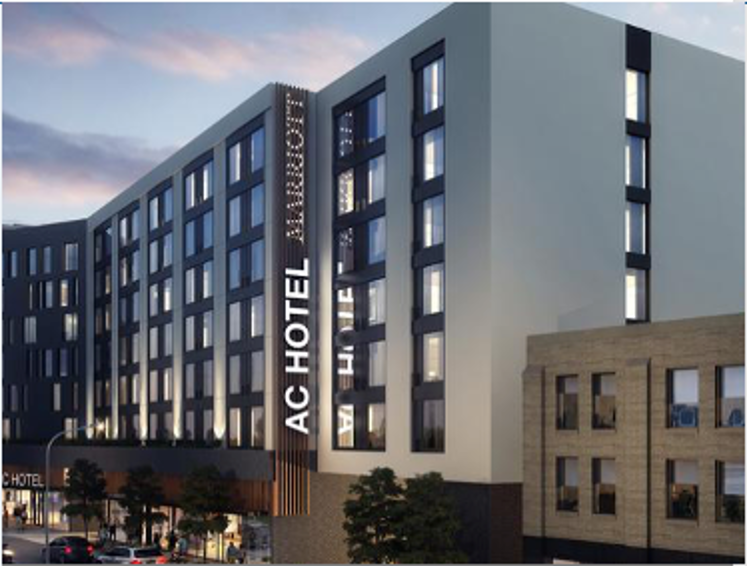
Another example is AC Hotel Marriot in St. Louis, Missouri, a 192-room boutique hotel. CounterpointeSRE was able to provide a $4.6 million 20-year fixed-rate C-PACE financing assessment and deferred the first repayment for two years, reducing development costs and allowing the property to stabilize. The combined annual savings of efficient HVAC and lighting solutions total roughly $60,000, and the total economic benefit of the improvements is estimated to be $5.4 million over 20 years. The use of C-PACE avoided $4.3 million in capital costs for the developers.
Hypothetical Scenario
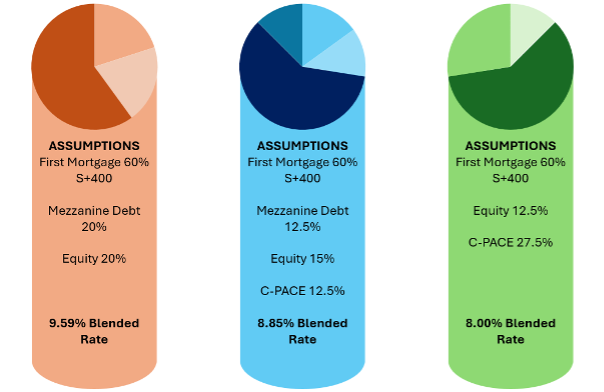
Here, developers and investors are interested in a $100,000,000 project. There are three scenarios:
-
- First mortgage + mezzanine debt + equity
- First mortgage + mezzanine debt + equity + C-PACE
- First mortgage + equity + C-PACE.
While keeping the first mortgage portion the same and slowly increasing the C-PACE assessment, the blended cost of capital decreases, ultimately saving over 1.5%. This is reflected in a year one cost of capital avoidance of $1,587,500 and a five-year cost of capital avoidance of $7,937,500. It is important to note that the analysis does not contemplate the interest rate risk associated with most mezzanine financings or increased legal costs.
Summary
C-C-PACE financing provides benefits to every part of a commercial real estate project: owners, developers, investors, tenants, and local communities. Investors, owners, and developers benefit from cheaper capital, more operationally friendly debt service, and greater returns on investment. Using C-PACE to bring down the blended cost of capital means more deal potential for both lenders and sponsors. Investors and developers have more equity available to invest in other projects, and property owners have more equity available to further improve their assets. Tenants and communities benefit from beautiful, sustainable properties that reduce their negative impact on our environment. It’s win-win for lenders, tenants, owners, government, and all stakeholders in the real estate community which is why C-PACE is transforming how commercial properties are being financed.
Sources
-
- Project eligibility contingent upon regional program and legislature
- Financing structure contingent upon regional program and legislature
- Zhu, C., White, A., Mathew, P., Deason, J., & Coleman, P. (2018). Raising the rent premium: Moving green building research beyond certifications and rent. In Proceedings of the 2018 ACEEE Summer Study on Energy Efficiency in Buildings (pp. 7-1–7-12). https://bies.lbl.gov/sites/default/files/Raising%20the%20Rent%20Premium%20ACEEE%20SS18.pdf
Important Disclosure
The information contained in this article is provided for informational and educational purposes only and should not be construed as investment, legal, tax, accounting, or other professional advice. Nothing contained herein constitutes a recommendation, solicitation, or offer to buy or sell any security or investment product. The opinions expressed are those of the author as of the date published and are subject to change without notice. Any forecasts, estimates, or forward-looking statements are based upon assumptions and current market conditions and are not guarantees of future results. Investing involves risk, including the possible loss of principal. Past performance is not indicative of future results. There can be no assurance that any investment strategy will be successful or that investment objectives will be achieved. Information presented has been obtained from sources believed to be reliable; however, CounterpointeSRE does not represent or warrant its accuracy, completeness, or timeliness. Readers should not rely solely on the information contained herein when making investment decisions. This blog is intended for a general audience and does not take into consideration any individual’s specific investment objectives, financial situation, or particular needs. Before making any investment decision, readers are encouraged to consult with their financial, tax, legal, and other professional advisors. Reading this blog does not create an investment advisory relationship with Counterpointe SRE. Advisory services are offered only pursuant to a written advisory agreement and only in jurisdictions where CounterpointeSRE is properly registered or exempt from registration. Any links to third-party websites are provided solely as a convenience. CounterpointeSRE does not endorse, control, or guarantee the accuracy or completeness of information contained on such websites and assumes no responsibility for their content. The case studies provided are for illustrative purposes only and do not constitute a recommendation to buy, sell, or hold any security. Such examples may not be representative of all investments made on behalf of clients. It should not be assumed that investments identified were or will be profitable, that their results are necessarily representative of CounterpointeSRE’ s overall results or that CounterpointeSRE will be able to effect similar investments in the future.